A Soyinkian Reading of Pope Leo XIV’s Magnifica Humanitas
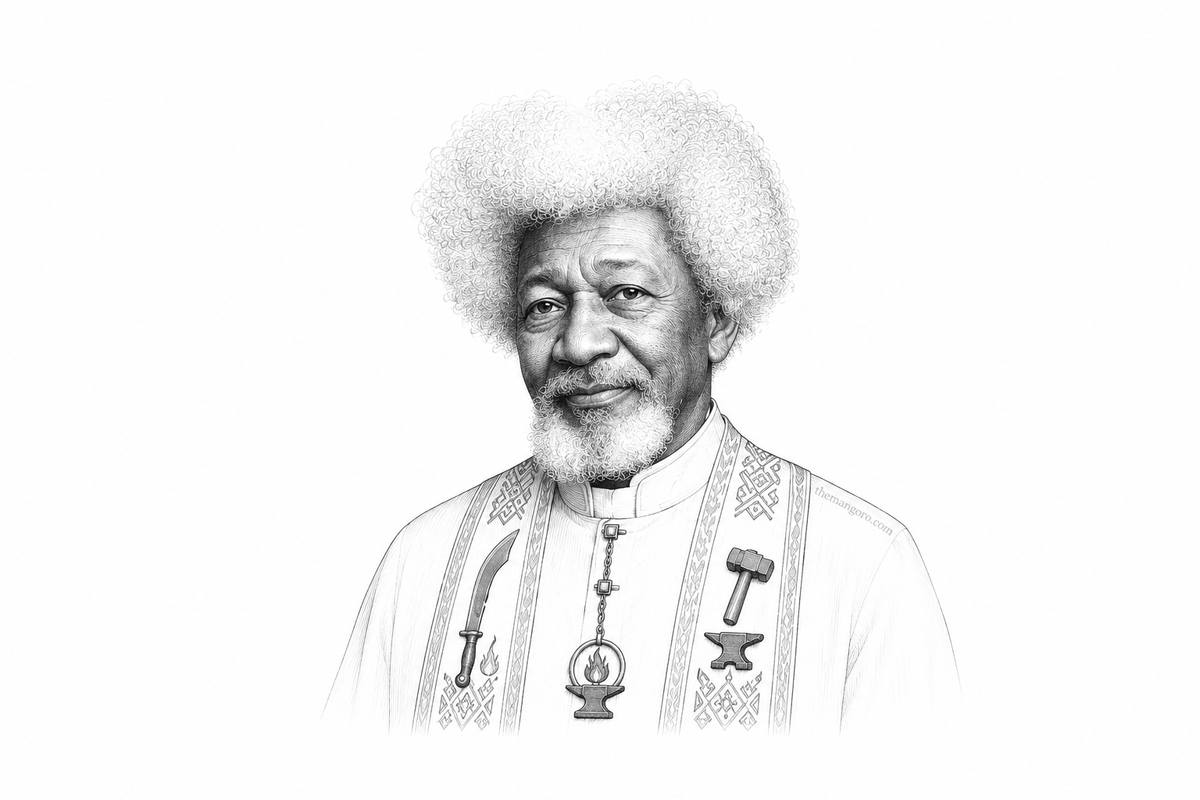
Pope Leo XIV has given the age of artificial intelligence its first great theological image. In Magnifica Humanitas the encyclical establishes two opposing building sites. One is Babel, the real estate of human efficiency, built because men wanted to make a name for themselves. The other is Nehemiah's Jerusalem, the city where God and humanity live together. One imagines it as a sprawling metropolis, built by a patient construction team under divine supervision. The pope's document says no technology is neutral because it tends to reflect the character of those who design, fund, use and regulate it.
It is a beautiful image worthy of critical consideration. It evokes Augustine's binary frame that sees the world as two cities battling over the soul. Viewed through another lens, the choice between Babel and Jerusalem says more about their architects than about the materials used in their construction. So I read the encyclical from a place the Vatican is unlikely to look at: the workshop of the Yoruba deity, Ogun.
My scripture is Wole Soyinka's Myth, Literature and the African World, a book from his Cambridge lectures. It argues that African metaphysics is internally coherent and does not yield to the European tendency to split. I borrow this posture, and I am carrying it to Rome.
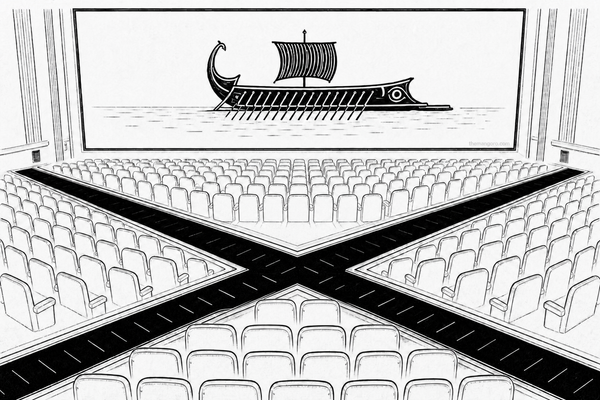
In the essay "The Fourth Stage," Soyinka gives Ogun his fullest reading. Ogun is the god of war and the road, of iron and the forge. He is also the patron of poets and hunters. This multiplicity, embodied in a single entity, leads Soyinka to say that Ogun is "a totality of the Dionysian, Apollonian and Promethean virtues", the Greek principles that the European orientation has always separated.
Besides being a master craftsman, he is a drunkard who kills his own. A reluctant king happiest left alone with his tools. In essence, the Yoruba philosophy keeps these contradictions and tensions whole: a deity that holds creation and destruction in the same hands.
The underlying myth behind the reading is a story about the first technology. Human beings and the gods used to live together until they were divided, and a vast gulf opened between them. This space, Soyinka teaches, is the fourth realm, the abyss of transition that lies between the living, the dead and the unborn.
The gods then decided to cross but could not. Enter Ogun. With a tool (the first tool) "forged from the ore of mountain-wombs," he successfully created a path through chaos and called everyone to follow him across. He became the first to conquer transition, becoming the god who made the road on which everyone and everything else could travel.
He was made king of Ire, a position he reluctantly accepted. On an occasion when he went to war, while resting, Esu, the trickster, presented him a gourd of palm wine. He drank it. In the drunken battle that followed, he lost the ability to differentiate his men from the enemy and cut both. Praise-singers keep the memory alive: "Ogun kills on the right and kills on the left." The toolmaker and slaughterer appear in one body, motivated by one will. Soyinka's intuition recognises that the creature who simultaneously builds and crafts uses the same tools for slaughter.
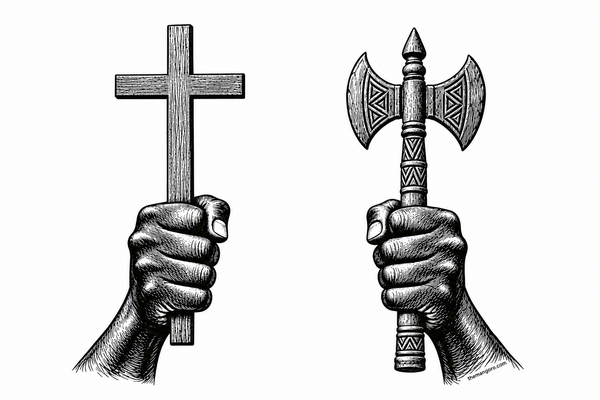
Bring Ogun into the same room as the encyclical. Magnifica Humanitas asks whether artificial intelligence is Babel or Jerusalem and recommends orienting it towards God to redeem it or keep it under check. Ogun knows no second city or any orientation that cleanses the forge. Something breaks when you keep the instrument that crosses the abyss and strip out its power to kill. It is one instrument and one will. The four hands that the encyclical separates (devise, fund, use and regulate) are what Ogun closes into a single fist. The danger is beyond our machines or about Babel. It lives in the thing inside the culture that is known but not mastered. A theology of AI that began here would not worry much about the question of which city to build but ask whether we have grown enough to carry what we forge.
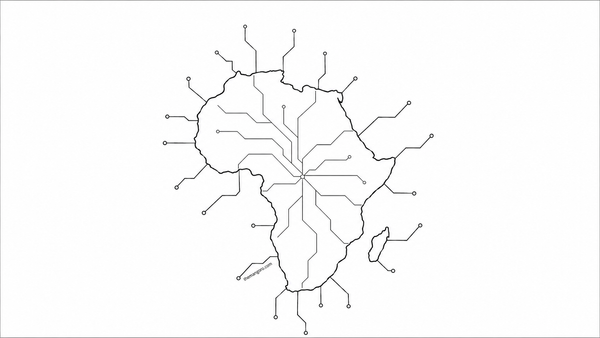
Soyinka stretched Ogun further, or rather, he saw the modern manifestation of the god early. In his poem, Idanre, Ogun appeared in electrical pylons, present in the high wires and threaded through the modern infrastructure that hums under everything we build. It is easy to find him again in electric vehicles and data centres. He will remain the god of anything we forge but cannot fully control, which is the closest definition of the machine now being raised in California and Shenzhen.
This frame carries costs that experts on Soyinka's works rarely admit. To some extent, this "Yoruba worldview" is largely his own invention. He fashioned his Ogun in argument with Nietzsche's Birth of Tragedy, and published the essay in a volume honouring the British Shakespearean G. Wilson Knight. The field correction came later, when the anthropologist Sandra Barnes assembled Africa's Ogun and found a deity more plural and more local than the single figure Soyinka required. Paulin Hountondji made a charge against a single anonymous "African worldview," advocated by a luminous mind, because of the potential consequences of freezing a living plurality into a myth. The charge has its flaws, but it gives a decent perspective. Augustine's The City of God and its influence on Western thought is also the work of a luminous mind. It reads scripture through Plato and Roman law by condensing centuries of inheritance into a binary that would later seem eternal.
Whether as cosmos or doctrine, the fact is that the two constructions build things. The question is which of them better explains or accounts for the use of tools. This is where I think Ogun is stronger because he rejects the second city, though not a guarantee of safety.
In his Ogun Abibiman poem, Soyinka invokes Ogun to bless the war of liberation, and the god gladly responded. The same tragic hero that crossed the abyss now dignifies the carnage instead of restraining it, admitting the very Promethean impulse the encyclical fears. If this essay is read by those training frontier models, they may feel flattered that their road is the only road across or proportionally the better alternative. (One remembers how some builders of the bomb that levelled Hiroshima still justified its necessity in the face of moral ambiguity). Augustine at least gives them a brake. A two-city construct means one of them is wrong, and a man can be told he is building the wrong one. Ogun gives him catharsis, which may be worse than nothing on a Tuesday when the loss curve is still falling. I cannot fully answer how. But I can say Ogun names the danger even when he offers no remedy, and a true but untreated diagnosis is closer to honesty than a cure applied to the wrong sickness.
I have carried Ogun to Rome as a peer and cosmology that stands on its own and owes the encyclical and the disembodying wisdom of Silicon Valley no deference. Soyinka has always wanted that for Africa, a seat at the table of first questions instead of a chair in the corridor. That should be understood in a contemporary sense as a call for Africa to admit itself in the centre of the unfolding of the new world, both philosophically and technically.
The encyclical presents Augustine's two cities as if they represent every human reality. As this essay proclaims, there is another tradition older than Augustine, in which the toolmaker and the destroyer are the same entity, and the road across the abyss is the one we forge ourselves, carrying the cutlass that saves and kills.
The Magnifica Humanitas asks which city we are building. Ogun wonders if that was the right question. The cutlass is one blade.