When Èṣù Watched The Odyssey
Christopher Nolan returns Homer to the cinema. Watched through Èṣù’s eyes, The Odyssey becomes a story about recognition, consequence and what the road demands from those who think they understand it.
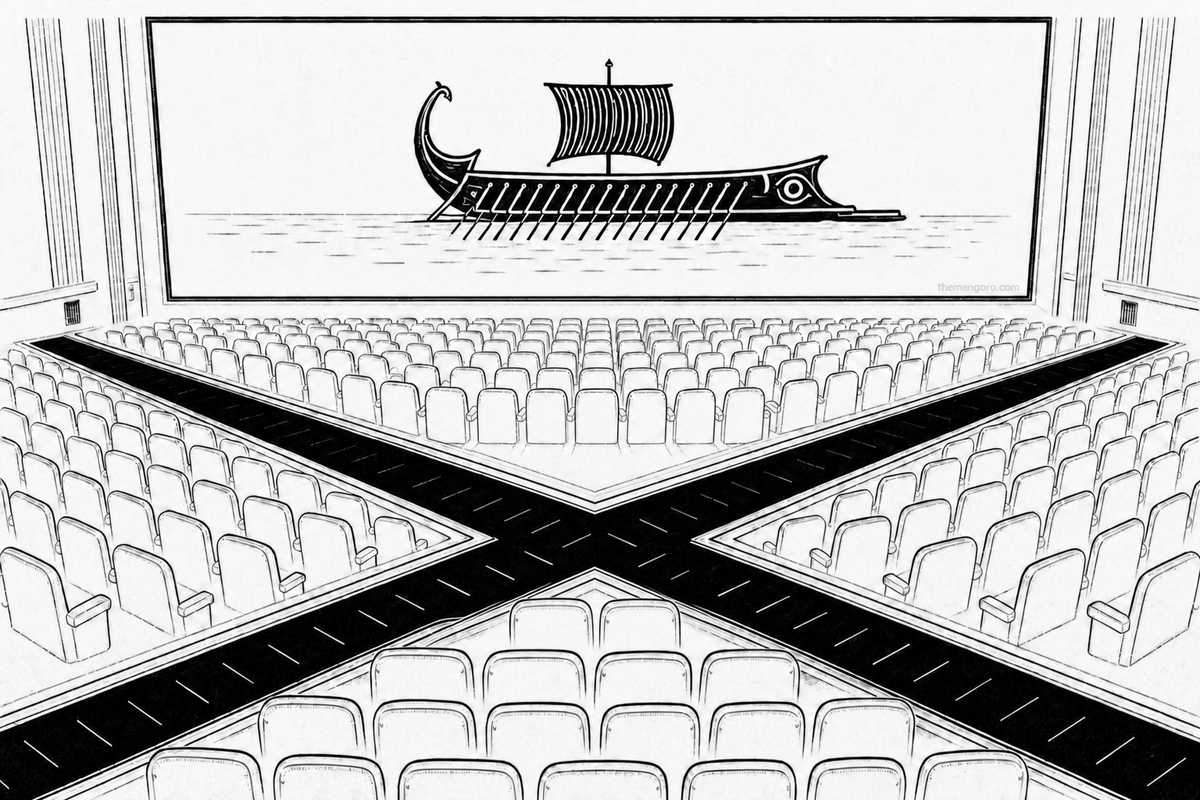
I am in Lekki, watching The Odyssey by Christopher Nolan in IMAX cinema. On screen, Matt Damon appears on the deck of a ship. Waves rushed towards the screen. Two rows ahead from me, someone laughs when Odysseus lies to get away from trouble.
I imagined another spectator in the cinema who decided to take a seat where the aisles intersect. He immediately recognises the sea as the road of abrupt turns and undisclosed plans. He knows stories like this, although Homer never spoke about him.
This spectator was Èṣù.
According to Yoruba philosophy, Èṣù lives at the crossroads and carries messages between humans and the divine world. He appears when a simple choice hides its true meaning and observes promises and consequences. This is where Odysseus spends ten years.
Nolan understands the hero he is filming. Odysseus succeeds thanks to his ability to adapt to a situation. To the Cyclops, he introduces himself as Nobody. At Ithaca, he returns to his home disguised as a beggar. He does not reveal himself until revelation serves some useful purpose.
In the poem, Odysseus gets enough warnings. He visits the underworld to get a prediction from Teiresias regarding the sacred cattle of the sun, suitors devouring his property and the future challenges awaiting him even after Ithaca. The prediction is clear. But a warning would only benefit those who are able to follow it. In his case, a warning cannot control hunger or pride.
Ifá brings into play knowing and responding together. A casting by a babaláwo, the message of an odù concerning both the issue and what needs to be done. The response might require waiting, mending or ẹbọ. Èṣù carries the offering and connects interpretation with consequence.
As Professor Wande Abimbola explains, Èṣù is a neutral force whose reaction depends on the actions of an individual and on the circumstances of an encounter. The usual division between goodness and wickedness cannot contain him.
Greek religion also had prayer, sacrifice and offerings. Its gods could be approached, pleased and angered. The difference here is one of emphasis. In The Odyssey, prophecy often gives Odysseus a road that he must travel carefully. Ifá makes the response to revealed knowledge part of the consultation.
The scenes of disaster appear differently from Èṣù's seat. Odysseus blinds Polyphemus and escapes, before shouting out his real name across the sea. The name is his address on which the curse of the Cyclops falls.
Homer recognises such errors as foolishness and divine anger. Èṣù draws our attention to the duty hidden inside every piece of knowledge. A name can save a man and expose him. A warning can become another temptation. Odysseus and his crew repeatedly understand enough to continue, then fail to honour what they know. The crossroads always remembers the difference.
Many Nigerians first encountered another Èṣù. In the Yoruba Bible associated with Samuel Ajayi Crowther, the Christian devil took his name. Generations learned to hear Èṣù as an accusation, and the deity of thresholds entered a Christian story as absolute evil.
The work of Crowther and his collaborators also helped standardise written Yoruba and opened an immense literary inheritance. Scholars continue to debate the theology and fairness of the translation. For many Yoruba Christians, Èṣù arrives already judged.
On screen, Athena moves through borrowed faces. Signs come from the gods, but human beings must understand them in time. Nolan’s IMAX sea enlarges the problem. It is vast enough to swallow intention. For a brief moment, anything seems to be possible in all directions.
When Odysseus finally reaches Ithaca, he stands on his own shore believing he has landed somewhere else. Then the failure reverses. Ithaca cannot recognise him too. He enters his compound in rags. Only Argos, his old dog, knows him immediately. The dog dies on the dung heap where he has waited for twenty years.
Hospitality runs through The Odyssey. A stranger walks into a house and shows what kind of people live there. Zeus is always there to protect the stranger because every stranger might bring divine attention into the house. Yoruba stories know a similar test through Èṣù’s disguises. A person meets an ordinary traveller at the roadside and later discovers that the roadside had become a court.
The suitors are offered a beggar to feed. They throw a footstool at him. They think they are judging a powerless stranger. But the stranger judges them quietly. Their failure is complete even before the arrows fly.
Homer’s ending has a structure that a Yoruba person would recognise: redemption waits at the threshold inside someone thought of as an unimportant. Greek hospitality gives the scene its law. Èṣù gives it another witness.
The end credits started rolling. The lights come up in Lekki. People looked at their phones and started discussing how Nolan had changed things. Outside, rain sits in the potholes. Cars move to join the traffic headed for the toll gate. Brake lights gathered under the concrete. At the barrier, every driver stops.
One by one, the barrier raises itself.