On What Ground Does Africa Think?
Africa’s intellectual future depends on deeper cultural memory, stronger institutions and thought rooted in African life.
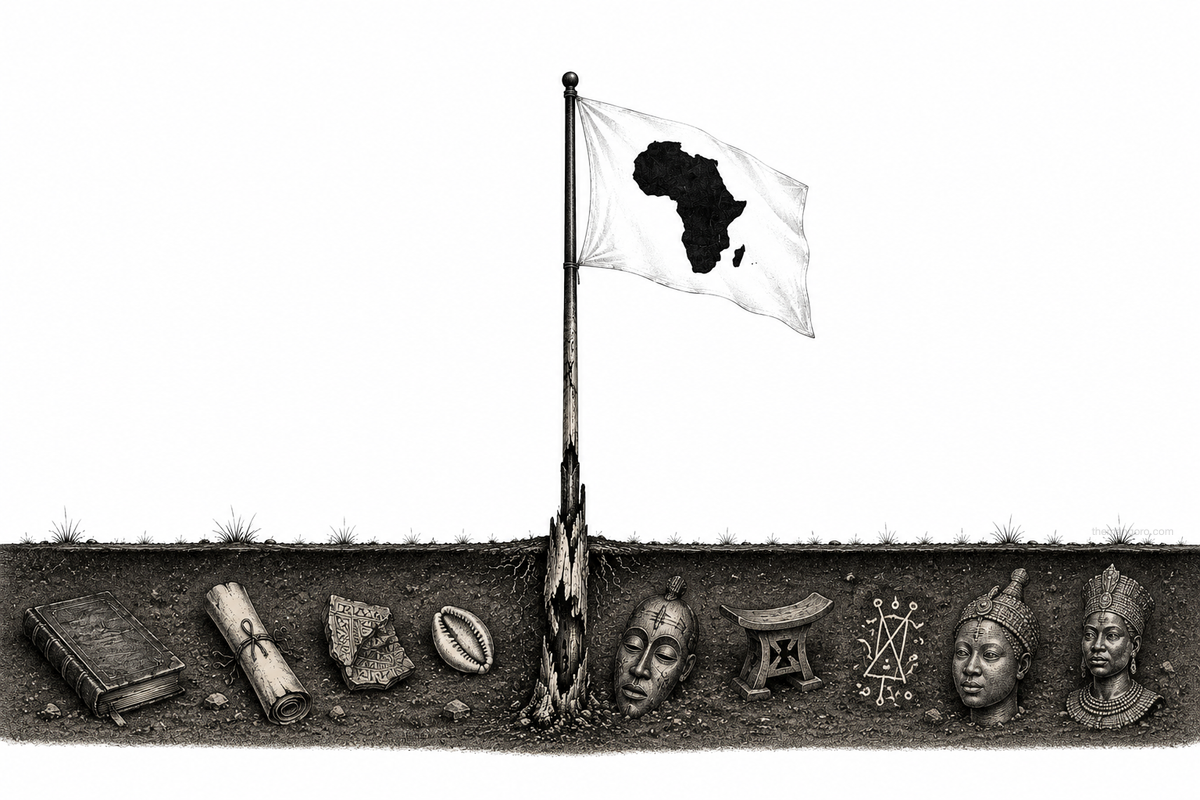
A paper titled Fourth Heritage Attention is All You Need circulated in some corners of the African internet. Written by authors from Uganda’s Fourth Heritage Initiative, its central metaphor borrows from the famous 2017 machine learning paper, arguing that the African mind is shaped by what it has been trained on. Its inherited data, tribe, religion, and colonial modernity have produced what the authors call porous minds, which leak focus, seek certainty through superstition or borrowed prestige, and struggle to sustain long-horizon thought. As a remedy, they proffer a fourth heritage that retrains attention and reweights other inheritances.
Essentially, the paper asks: on what does Africa stand when thinking on its own?
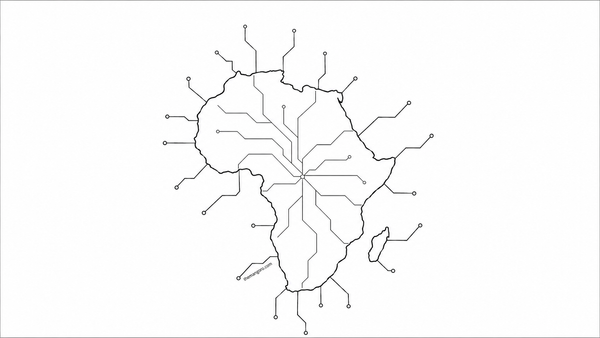
To answer that would, firstly, require admitting that there is no single African experience because the continent contains 54 countries, thousands of languages, multiple religions and sharply distinct colonial inheritances. The Maghreb belongs as much to the Mediterranean and the Islamic world as to any sub-Saharan affiliation. Ethiopia carries a Ge’ez literary tradition that is older than many European national cultures. Any project that ignores this diversity and reality risks flattening it. The Fourth Heritage paper limits its argument to tropical Africa, in which what follows also describes a poster.
My favourite part of the paper is its taxonomy of killer mindsets: the inferiority complex, victimhood, self-hate, herd mentality, copycatism and the African elite dilemma. The initial five echo Fanon, Biko and thinkers from their tradition. The sixth is fresh. With it, the authors claim that as Africans become more educated and more globally competitive, they often become more detached from the African orientation that formed them. This gives birth to the strong and rather convincing notion that African societies raise intelligence that later serves the priorities of foreign institutions. They call this scattered intelligence. Quite a phrase.
And shallow collective memory. People are shaped by what they can remember and pass forward. Jan Assmann distinguishes between communicative memory (lasts roughly 80 years) and cultural memory (lasts for millennia). The authors apply this distinction to African societies because the memory infrastructure that holds the societies is currently fragile.
The argument invites a closer look. The authors propose a Heri, an architecture that relates to identity, cultural orientation and creative discipline. They claim that Japan possesses one, a deep commitment to work perfection, while Africa does not. But no civilisation can be reduced into a slogan without losing some essence. The Japanese cultural posture is actually closer to kata, the disciplined practices of inherited form through which mastery passes across generations. Kata is a posture, far from a catchphrase. The same is true of any serious civilisation.
At independence, most African societies lacked a shared intellectual posture robust enough to absorb modernity without dissolving into it. By contrast, India retained its Sanskritic traditions post-independence. China maintained its Confucian administrative heritage. Same as Vietnam, Korea and the Arab world. They drew on other deep continuities, as each possessed traditions that act as an intuitive immune system during political recovery.
It was, and has been, harder in Africa because colonialism fractured language and institutions. Add the slave trade, and we have an impossible design for a single civilisational posture.
This has been a concern for African philosophers. Valentin Mudimbe made the case that "Africa" was largely a European construction and then inherited by intellectuals and a new elite. Paulin Hountondji separated ethnophilosophy, the Western narratives of what we Africans supposedly believe, from the philosophy we actually do. There have been calls for conceptual decolonisation that allow for thinking through African categories rather than those translated by Europeans.
These projects share a claim that the author's paper reaches without explicitly naming. By addressing African problems on African terms, African thought becomes generative when it stops facing an outside audience. This is a better posture than prescribed content. A thinker standing on African intellectual ground asks different questions and produces different artefacts from someone who stands elsewhere and reaches back to Africa for materials.
To clarify this difficulty, Soyinka famously quarrelled with Senghor and Ali Mazrui. Soyinka mocked Negritude with his famous line that a tiger does not proclaim its tigritude; it pounces, to which Senghor replied that the tiger does not proclaim itself because it is an animal. Because humans constitute themselves through symbolic life, to refuse articulation is to refuse part of our humanity.
Soyinka criticised Mazrui's The Africans: A Triple Heritage for placing Islam and Christianity beside indigenous African traditions since both religions entered much of Africa through coercion and conquest. Mazrui responded that Soyinka was claiming the sole power to determine who should be sufficiently counted as African.
They were both partly right. Soyinka saw the violence hidden inside the language of inheritance. Mazrui saw that purism could erase the Muslims of the Sahel and the Swahili coast. A rooted African posture would need to hold both truths. The imported traditions require criticism. It is also true that centuries of African life have also remixed them.
What might then serve as the ethos the authors seek? I propose one: Ubuntu.
Through popular usage, Ubuntu has been reduced to a phrase that mostly lives on T-shirts and appropriated into corporate language. In Mogobe Ramose's work, Ubuntu carries real weight. "I am because we are" admits that knowledge is relational and the isolated and overly individualised self is the wrong starting point for communal negotiations. Similar ideas appear in sankofa, àjùmọ̀ṣe and igwebuike. Across different African thoughts, obligations and inheritances emerge in the context of relationship from which it draws and serves.
The paper is right that Africa needs a generational project of mental retraining. But this must happen through rooted thinkers and institutions. The Knowledge Tower the authors imagine will rise one book, one essay, one library and institution at a time, all served within an Ubuntu framework. These builders would first answer African questions, without resentment or reservations.
Mangoro is a small attempt at this posture, addressing Nigerian and African readers first and serving them without dumbing down to suit popular or merely commercial obligations. Others are welcome to join.
The Fourth Heritage authors have done something rare by making criticism part of their framework's legitimacy, and to add, legacy. Different from movements of African renewal that end up hardening into orthodoxies because they perceive criticism as betrayal and affront.
Mangoro enters that argument with two points of disagreement. Thinking happens within communities that make judgement possible and a civilisational ethos cannot be built in the shape of a slogan. The agreement is on the urgency and need to rebuild Africa’s intellectual ground.
The conversation has begun. The rest lies in the writing, the institutions and the slow work of standing where Africans already stand but standing there more deliberately.
Recommended reading:
The Invention of Africa (Mudimbe, 1988);
African Philosophy: Myth and Reality (Hountondji, 1983);
Cultural Universals and Particulars (Wiredu, 1996);
African Philosophy through Ubuntu (Ramose, 1999);
Communicative and Cultural Memory (Assmann, 2008);
Fourth Heritage Attention is All You Need (Kirunda, Muganzi and Kisakye, 2026).